
Freak Show: A Conversation with Homer Flynn

“I hadn’t planned for this conversation with Homer Flynn to happen. It took place over a thousand days ago in a busy restaurant, a couple of hours before The Residents would perform their 50th Anniversary show. I was asked to review the event for a music magazine I had been working for, as I’d already bought a ticket. On that morning I took the coach from Glasgow down to Leeds, and while in transit, I received a text from the promoter asking if I’d like to interview Homer. My editor at the time declined to run the interview, but Organ Bank later expressed an interest in publishing my transcript. I got word afterwards from the promoter that Homer had enjoyed the conversation, so I hope that readers will too.” – Kay Logan
KAY: I think if there’s a historical weight to The Residents, it’s this idea that you disregard external influence or expectation.
HOMER: Yeah, thank you, thank you.
K: If you’re someone who’s on the outside, it demonstrates remaining true to that despite the pressures of the external world.
H: Yes, I second that. I second that entirely. What you’re saying really resonates. The Residents really started out seeing themselves as artists first and not as musicians, but music felt like their channel into the culture. The doors were swinging open, and they went charging for it. And you know, they’ve never considered themselves to be great musicians. They’ve gotten much better as they’ve gotten older. But at the same time with multi-track recording, they’ve then got a way to create a band, because they could get in and build track by track. And they’d look up to great musicians to do that, and in a way, that was a kind of connection to the values of those musicians. I think that can be an interesting thing to navigate if you’re someone who is socially marginal and you meet other like minded individuals.
K: I’ve always felt there was a sort of pessimism to it.
H: Yeah, well, there’s certainly a dark aspect to it, but they’ve always felt as if, you know, as if they undermine that to a certain extent with humour. It’s kind of like, you know, the expression, every cloud has a silver lining, or every silver lining has a cloud.
K: I think there’s a kind of Southern Gothic aspect. I grew up in a deindustrialised mining village in Scotland, and I always related to that sort of thing. There’s the pessimism and the gallows humour, but there’s also a kind of compassion underneath it all.
H: Oh absolutely, yeah.
K: But I think it’s beautiful. If you’re someone who has a pessimistic outlook from living that life, and you’re drawn towards artistic expression of it, and then you get to discover this compassion underlining it all.
H: I don’t know about Scotland, but the Southern Gothic, think it’s very repressive, and you know, that repression, if you’re living there, that’s not necessarily the most fun thing in the world. Particularly if you’re someone who thinks in a different way. If you’re fortunate enough to be able to escape, once you get to the other side, you discover that repression is an incredibly rich source to draw from a creative point of view. I mean, The Residents definitely relate to Tennessee Williams. You know, that’s exactly the same thing. One of my heroes is Sun Ra. He grew up like, totally weird and outside, and was able to escape, and he became, you know, a visitor from outer space. And I love that.
The time I grew up, there was the mythology of the talent scout. And if you were really good, you know,
well sooner or later, unless you’re unlucky, the talent scout’s going to find you. They were going to open the doors for you and whatever. I don’t know if it’s a distinguishable phenomenon any more because of the dissolution of the formal model of how the music industry works, but at least throughout the 20th century, up until now, there have been a lot of points where the establishment tries to figure out, okay, this is the way we’re going to buy our way into the avant-garde. We’re going to be able to turn this esoteric thing that’s driving the counterculture into a definable product that we can sell. I mean, it happens. It happened in the 60s and the 70s, and again the 90s. All of a sudden record companies would just have a lot of money to give weird artists to see if they would make the next kind of thing that would inspire youths to buy records from them. I think that sort of thing, it’s very at odds with the culture now, so you really have to be self-sufficient.
I think this culture at large waves away the idea that you can live your life by doing this sort of thing. It wants social media engagement, these sorts of things, a fascination with celebrity and cult of personality, which is kind of the antithesis of the theory of obscurity. Maybe it’ll come back again at some point. There were these periods when doors would swing open, and all these new ideas, when The Beatles came along, the British Invasion, and all these new groups got to come in. And then ten years later or whatever, there was punk, and new wave. It was a very interesting time, and then, in the 90s when the doors opened, there were all kinds of opportunities that came along with interactive media. But the problem was that it was the very threshold of new technology, which hasn’t been developed a whole lot beyond that. If you look at that stuff now, it looks very crude. I don’t think the developments since have necessarily been good in a lot of ways.
K: A lot of people have nostalgia for those interactive media CD-ROMs, even if they didn’t experience it the first time around.
H: The problem is you can’t find computers to run them.
K: I got The Residents CD-ROM stuff to run on my computer.
H: Yeah, well good. There’s a guy who has taken Bad Day on the Midway and turned it into a website, you can go to it and play the whole game right there. I think it would be great to go back and redo that stuff, but it’s expensive, and at this point, I don’t know if anybody sees the market. It’s not going to allow them to get that money back.
K: People are independently making stuff inspired by that era of interactive media, but it’s niche.
H: I remember we did a thing with the Inscape founder, we talked about this potential that interactive media had, but I think it hasn’t been quite realised despite the massive development in video games.
K: Video games have become very centralised and monocultural, but interesting stuff is still happening on the outskirts.
H: Although interestingly, we connected with some people a few years later, they were like, animators for Saturday morning cartoons. The idea they had, which I thought was really fascinating, was to do a series out of it, but make the entire series happen in one day. But then somebody came along and offered them Starship Troopers.
K: I don’t know if you remember a title Inscape published called Drowned God. It was by a writer who lived in Scotland, it had this amazing soundtrack which reminded me of The Residents.
H: Michael Nash was the editor of Inscape. Michael and I have kept up with each other. He’s a really interesting guy, and right now is head of digital media for Universal. Pretty high up position. I think he would love to work with The Residents again, but it’s not exactly in the world of Universal.
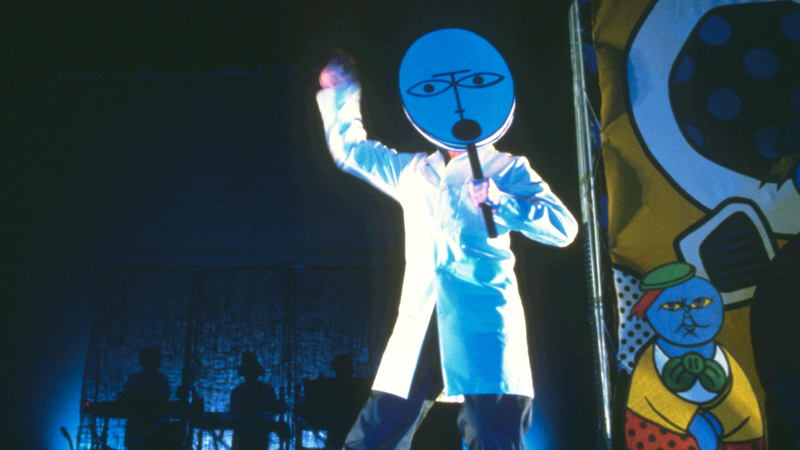
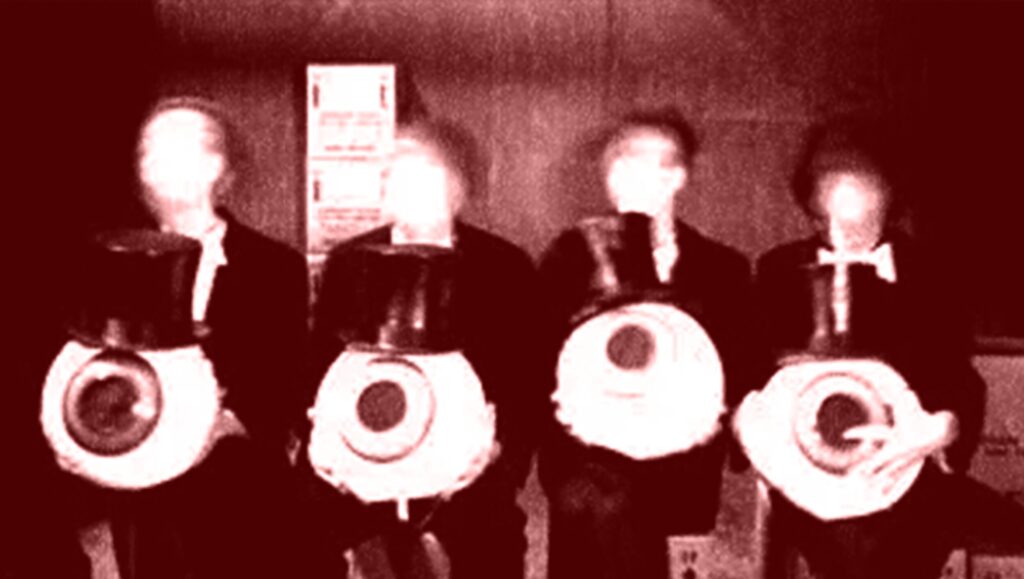
K: Do you think we’ll see another fifty years of The Residents? Are the masks going to be passed on to new folk?
H: Well, that’s the question. It comes up on a regular basis. And you know, The Residents are definitely open to that conceptually. I suppose artificial intelligence could be one way to perpetuate it, although it’s hard for me to imagine that something wouldn’t be lost. Somebody sent me some Residents lyrics written by artificial intelligence, and I read it, and it’s kind of like, yeah, kind of. They totally got it from a broad strokes point of view, but the nuance is lacking, completely lacking.
K: How do you feel about that technology? I used to think we could use machine learning to build some new kind of musical instrument, but that doesn’t seem to be where it’s headed.
H: You know, it’s like for me, so much of what I do ultimately is collage. I’ll scour the internet looking for things, and then I’ll take them and cut them up, do
whatever it takes to make it my own. When the first samplers came out, The Residents had one of the first, the EMU Emulator. I think The Residents had Emulator number 005 or something, you know, Stevie Wonder had number 002. But I can remember seeing that in the studio, it’s like, you press a key and it sounds like a real violin. I remember thinking at the time, well, that’s it. That’s the end of the violin. It wasn’t very long before I looked back and thought, how naive. The reality is that if you’re a real artist, you have a unique and personal voice. You can’t replace it. It’s the same with this stuff. The true genuine artist has a unique voice, and it’s impossible to replace them. No computer’s going to do that.