
Concrete Mansion

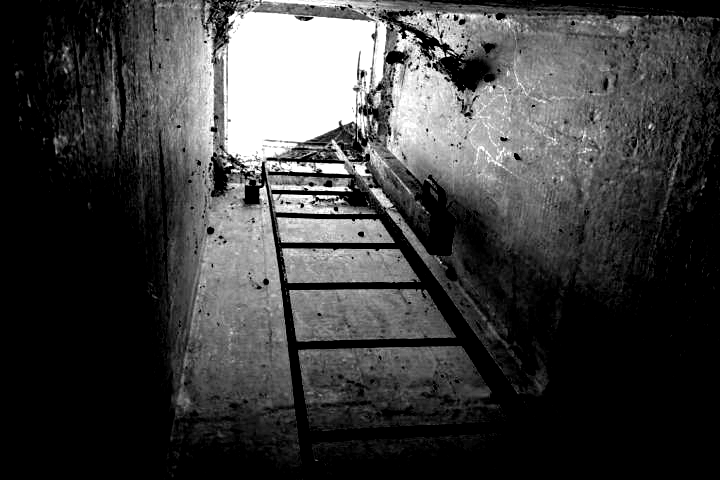
Within the foyer of the Concrete Mansion were four doors, a mezzanine, and a distant chandelier. The walls, floor, and ceiling were bare concrete. The floor was scraped and worn, the walls darkened by water stains. The mezzanine, also concrete, ran a square frame around the foyer. A wrought iron railing bordered the platform. Lacking any visible stairs or a ladder, the mezzanine could only be accessed through one of the three wooden doors on the second floor. The front wall contained a large rectilinear window. The small chandelier lit the room impeccably.
Looking up at the chandelier and the concrete emptiness, Henry remembered the foyer from a drawing. Sketched painstakingly on a sheet of yellow paper, he’d found it crumpled under the bed. Now, only moments ago, he’d scaled a sagging chain fence with orchids in its knots and stole across a moonlit lawn of weeds and white stones. Still, he wondered whether the entire mansion was inside a chamber of Clark’s desk. If he could reach the mezzanine and look out through the black window, would he see the purple moon above, or Clark’s glowing face, his brow drawn as he hunched over his creation, pen in hand, inking the wavering shadows?
The only other time Henry had visited the Concrete Mansion was at midday, on a picnic with Clark. They ate on a knoll overlooking the property. Clark made tuna sandwiches, and Henry brought snacks and cider. They’d been dating for two months. Clark told Henry he wanted to take him somewhere special. Henry did his best not to look at it while they ate, and welcomed every excuse to stare into Clark’s eyes. On the drive home, Clark asked him how he liked it — honestly — and Henry told him the truth. Clark laughed — I understand — and said they didn’t have to go back. Instead, it came back with them.
Behind the foyer’s third and only unlocked door was a long, narrow hallway with a peaked ceiling. The floor was covered with a dull red carpet torn in lengths and frayed at the edges. The carpet muted Henry’s footsteps. Tapered bulbs hung naked from short chains, buzzing. Every ten paces he stopped walking the hallway to try and open a wooden door on the left and then one on the right. The handles were stiff and clicked when rattled. The rare handful of unlocked doors hardly budged, opening inwards into barricades of stacked crates, chairs, or shelves. Jabbing a wide eye at any of the cracks the doors might afford, Henry peered into a thick abyss, or else upon the glow of an unseen bulb, flickering in vacant space.
The hallway ended at a juncture, opening onto two nearly identical hallways. The left hallway, which he took, was again lined with locked or barricaded doors and again opened onto two nearly identical hallways. So did the right hallway, and all of the long, narrow hallways after that. Walking the silent corridors, Henry remembered Clark’s soft mutterings. He noticed them the week after moving in: while shaving, driving, at the dinner table, at the grocery store, asleep curled up in bed — Clark, his voice barely audible, murmuring of corners and lights and long interlocking halls. The first time Henry asked, Clark claimed to never notice speaking in clipped descriptions and fragments of direction: they had just spilled out as if overflowing from his head. The second time Henry commented on a muttering, Clark said he was sorry. The third time, he called himself an idiot and apologized profusely. Every subsequent acknowledgment prompted similar bursts of self-loathing not easily quelled by reassurance. Eventually, Henry pretended not to hear them, and passing unnoticed, perhaps for Clark they no longer existed.
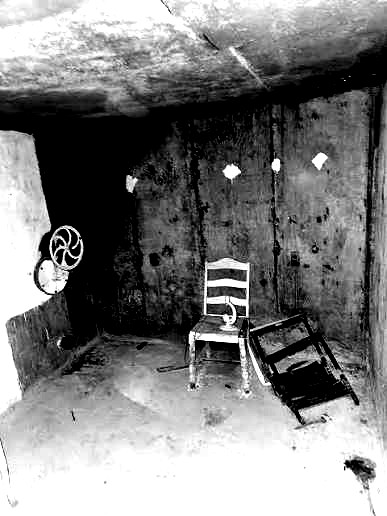
The few rooms Henry could access were little cubes, each roughly the size of another, some heavily water stained, others lightly so. The walls, floor, and ceiling were always untreated concrete. The tapered bulbs hanging naked from their short chains barely lit the broken chairs or porcelain shards no bigger than nickels, which in certain rooms collected with grime in corners. Some rooms smelled of petrichor, others as if incense had recently been burned. He remembered Clark at times muttering of the vents or ducts with tarnished metal grilles like the ones installed in the floors of these rooms, pressed against the back walls, opposite the doors. Henry couldn’t stick a pinky between the slits, and the vents lacked visible screws or hinges. Hints of a rank scent wafted up from shafts of unbroken darkness, borne on streams of cool air.
One wooden door like any other opened into a bathroom. Under fluorescent lights were three open stalls whose toilets were smashed or covered with brown canvas. A large sink stood beneath a mirror, tarnished to the point of uselessness. Where scum collected around the drain, Henry found an echo of where the pale — in places purple — bloat of the rotten thing sagged against the examiner’s table. The polished metal reflected the cheek which had grown to annex regions of the lips and nose. The belly had swollen, and no shoes would fit those feet. A line of tepid water dribbled from the faucet and Henry splashed the sweat from his face.
Behind a door was a phonograph on a wooden table and a picture of a rose; behind a door gently spun a ceiling fan; behind a door, bare bookshelves scraped the ceiling. He stood in rooms before a ticking clock, a railway spike rising like a mushroom from the floor, a little white moth clinking against a tapered bulb. Around the house he’d find these places scrawled on napkins or the backs of crumpled receipts — he’d see, on a hidden note, typewriter in shadow, empty carriage and drawings of a coffee cup smashed across a pitted floor. Watching Clark cook dinner, humming to himself or sharing workplace gossip, Henry pictured these spaces and things festering in all the shadows of his head.
In the long, narrow hallways with dull red carpets torn and frayed, with tapered bulbs hung naked by chains from peaked ceilings, Henry remembered how he’d solve mazes as a child, and turning right at each intersection, he reached only further hallways stretching on to further intersections. Had he already visited the room where a game of chess was abandoned two moves from checkmate, or had he only heard it whispered late at night? Did the dirt smeared across the floor form an ankh or a sickle? He stared out of a totally opaque window, unseen rain battering against it, and wondered if he’d done so before.
Henry was in a room with dark oil paintings of figures grave in antiquated garb. Beneath one of the portraits was a dead fireplace, beneath another, a small table with an empty tape recorder placed atop it. He wondered how he arrived there. It’d been weeks since the funeral and still the world was bifurcated, the base matter of life pronounced in one half while feeling was hidden out of reach within the other. Now he couldn’t recognize the room around him whose door was locked from the outside, whose portraits had perhaps changed and the fireplace was now aglow. But the firebox was not a firebox, and on hands and knees, Henry crawled through the long concrete tunnel towards the light coursing heat into the room.
Henry emerged in a crypt with oak-paneled walls. Stuffed turkeys, quail, and black pheasants crowded the corners, ravens and raptors hung from the ceiling with wings outstretched in mock-flight, vultures perched on wooden beams, a peacock exposed its plumage to the dead. In the center of the room, a great-horned owl was placed upon a pedestal with its wings spread wide. A black pistol lay in its outstretched talons. Henry took the gun. It was heavy and cold. He considered putting it back, but he didn’t.
Outside the room was a hallway wooden, warm, and furnished. Distant footsteps echoed from distant chambers. Henry called Hello? in a voice tiny and thin. Gun in hand, he stalked past dark, leafy plants on stools and dusty mirrors hung on walls. The hallway ended at a juncture, opening onto two nearly identical hallways.
Walking in silence down the corridors, Henry listened for the footfalls but heard only Clark in the back of his head, whispering in his sleep of sharp left turns, frayed red carpets, and tapered bulbs hung naked from short chains. Crouching, Henry heard his voice faintly from a silver keyhole inlaid between two columns in a bare black wall.
Every night since the funeral Henry only had one dream. In the dream he lay in bed, and Clark lay beside him, and sat hunched at his desk, and stood by the closet and bathroom and the foot of the bed, staring at the walls, windows, Henry. The room was hazy and warbling, shafts of light shimmered from the dark beyond the missing ceiling. Clark spoke in monotone of places odd and impossible, a bedroom where black brambles cover the furniture, a garage empty save for massive cobwebs draped like tapestries in the corners, a white hall of torn-out doors and whispers, and Henry found they were all exactly as he described. In a hidden room, a black glass sphinx shone on a mantle. The creature’s high face was placid, eyes softly closed and lips pursed tight. By flickering candlelight, a shape could be seen within its chest. Henry lifted the statue from the mantle, turned it in his hands. A hidden angle cut his palm, and the sphinx shattered on the floor. Blood and a brass key shone amidst the ruins.
Early one morning, Henry awoke to a sound in the hallway. The bedroom door was open and, lost half to dream, he saw Clark getting dressed in the warm light’s glow. He must have muttered for Clark, because Clark froze midway through putting on a shoe and just looked at him with such sad eyes. He stood in the hallway while Henry’s world grew dim. In the darkness before sleep, he kissed Henry gently on the forehead and whispered something lost. There were footsteps and a door opening to heavy rain, then closing, locking. Henry’s last waking thought was the certainty he would never see Clark again.
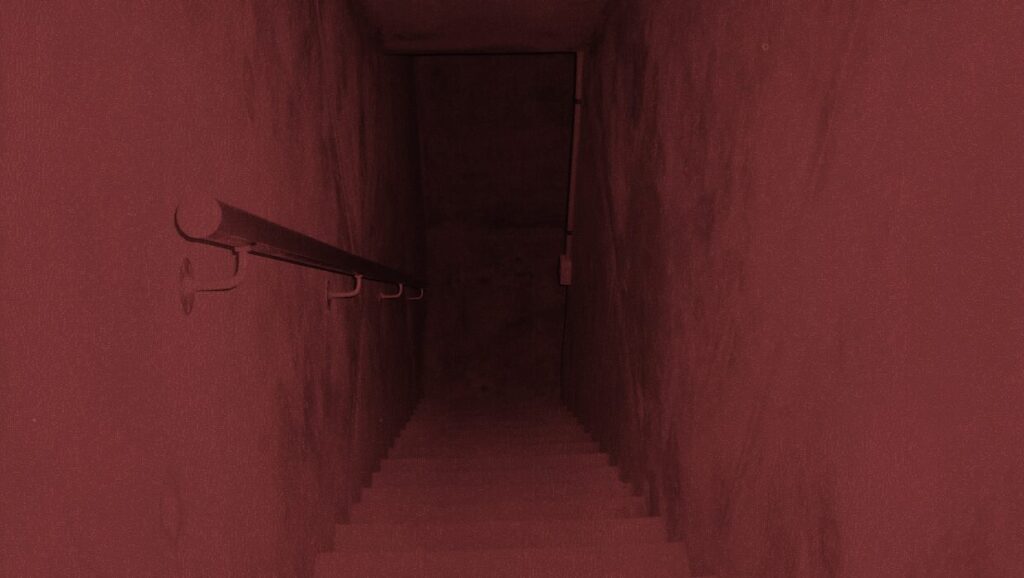
Down the stairs, behind the locked wall, into the basement, Clark’s voice was guiding him in his head, and then no longer in his head, echoing like footsteps from afar. Henry walked a labyrinth of a single hall coiled like an intestine. The walls and ceiling were concrete, tapered bulbs hung naked from short chains on the ceiling, there was no carpet and there were no doors. The voice spoke: vents lights stains torn cracked pitted concrete hallway. With every turn, the volume grew, and he followed its tones deep into the labyrinth where there was no more light. He navigated by keeping a hand pressed against the concrete wall, thinking to follow the voice, the cool air, the growing stench of something sour. The hallway ended in a room of luminous black curtains. They swayed gently in the rush of cold air. The voice called: black octagonal room black curtains heavy shadow from behind a curtain at the far end of the room. Henry approached the curtain. The stench flowed freely with the voice between the curtain’s dark creases. A leg reached between the folds and a body followed after.
Jesus fuck wait no Jesus, Henry stumbled backwards, wait no no no wait stop stop, and the gun was raised in quaking hands. The voice said: concrete floor concrete walls black curtains Henry Henry Henry and Henry pulled the trigger.