BULL MARKET- on Noam Hessler’s Officeparks

I: If Cheating
Noam Hessler loves words. This is the most generic thing one can say about a poet, even the definition of a poet, but once you get to the second poem in Officeparks, their debut book, and see/hear/read “fattoothed,” “Uppwards,” “Darkawful,” “Fatwet,” it is delightfully apparent that Noam Hessler loves words, especially aspirated consonants. The book is filled with p’s and t’s, and Noam even apologizes in the acknowledgments for their mouth and teeth obsessions. (Noam— some poets are last-namers, like Ashberу, whereas Frank O’Hara is Frank. I think Noam is a Noam, and will retain that stylism here, but it takes one to Noam.) Noam also loves that you can fit two or more words together and get more per-cent value than the original worth. I’ve been thinking of this as “commensurability.”
But you can only see commensurability as a theme in the second poem with knowledge of the first, and the first poem is doing something sneakier than its title lets on. “Poem Replacing ‘It’ with ‘Love’” opens with the sun — rises, sets, “crawls out from / The den in the arch of the sky,” “brighter, hotter, / Sweeter for — it knows / It will die.” Clean pronoun, clean antecedent, nothing to object to. Then: “Web-toed / And grimaced. It is / Drinking the paintwater, / After the abstract’s done in one.” No sun is web-toed. By the time “it” is drinking the paintwater, “it” has already stopped being the thing it was three lines earlier.
Which, fine, is just what “it” does in a lyric poem. Poets have been doing this since forever, it’s one of the Romantics’ favorite moves— Keats’s nightingale, Shelley’s skylark. What’s a little funny about this poem specifically is the title, of course. Most poems that pull this move do it quietly, you catch it or you don’t; this one’s got instructions. Instructions are going to be important here. Replace “it” with “love.” Go. Do it. And I think the poem is honestly a bit worse for being told what to do with it— some of the pleasure of a metamorphosis is catching it yourself, mid-air— but that worse-ness is what makes it a good first poem for the book. You don’t come away certain love was cheapened by standing where the sun stood, and you don’t come away certain the sun was elevated by the swap either.
Once “it=love” has taught you to ask the question, you start seeing it everywhere. The Minotaur poem asks it of a man and a bull. “Deepsea Lizardfish” asks it twice in one breath once of fear itself (“The only thing he fears is you. / The only thing you fear is him.”— perfectly reciprocal, a fear you could set on a scale) and once of two words: “You sit — a corpse, fat- lipped, fattoothed.” That’s the Joycean move: does welding “fat” to “toothed” make the word worth more than the two words held apart? And the poem opens by asking the question at a totally different scale before any of this— a photograph credited to NOAA, printed as text, standing in for the fish itself.
Some might call this good pacing. Noam calls it lining up the shots — a phrase that doesn’t show up until the Afterword, seventy pages later, where Noam finally explains what the front of the book has been doing to you, asking you to do? It’s a funny joke, put our instructions in the afterward and not the forward — or a great show of control over us poor captive audience, how easy it is to force us to go and read it all over again. I’ll cheat you out of that a little, sorry Noam, but this isn’t Officeparks. This is BULL MARKET, and here I call the shots.
“Lining up the shots” is shown through film first, then cards. Poetry “captures the impression of time” the way film does, an outlined poem as “a series of images, not a narrative, even in the case of a narrative poem”:
“A few good words [more of this] [the confession] [two-three juxtaposed images (internal rhyme)] [memory of the cruel man] [he talks about his shoes—four lines] [a frightening part] And yes, I left those cities on the plain.”
Then cards. A poem is less a song than a deck, Noam says, and then, a deck is “another medium where, if cheating, you can line up the shots.”
Two paragraphs after the cheating line, Noam tells you poems are found objects, that certain places “hold poems,” that “drafts of sharp wind… pick up poems and jam them into a poet’s head” — the exact rhetoric of discovery, of arrival without authorial hand.
II. Transvaluation, or: everything is worth a bull
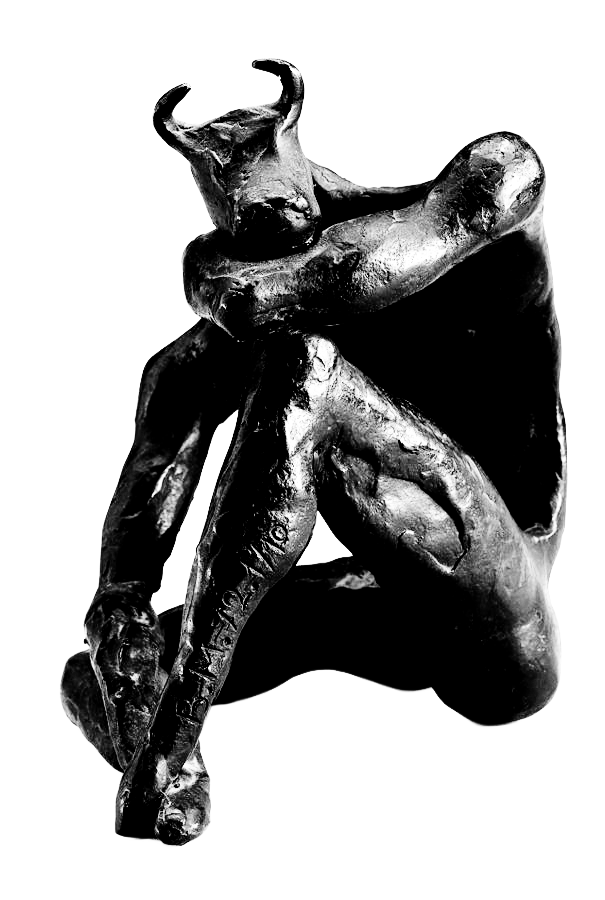
“In My Body: I’m the Minotaur,” a hinge of the book, the iconography of the cover. After the first stanza, in media res, of a completed transformation, we are given instructions of how to become the bull.
“Open yourself to the bull. Fold yourself inner like a prolapse Or a shrinky dink, all sticky In the oven. Feel the hooves. Lay down on the Sand of the lot, the kitchen floor Of the kitchen floor, silhouette yourself.”
We can perform this activity. We can try it out, and see if the bull and the man can come out even in ourselves.
Within the text of the poem, the results are inconclusive. The poem’s narrator’s bull isn’t always “there” even once the ritual is performed, it’s out roaming, and the narrator has to adorn themselves with bull-ish things to bring it back. The bull-suit isn’t the right shape, but the bull that enters the body is? And there’s the teeth again.
“Take a photo with the head of the bull / In a shopping basket, somewhere behind.” I don’t know if this is the poem being cruel to its own myth-making or if it’s just honest about where a ritual object actually ends up after the ritual’s over.
The poem ends: “The bull is here / And the man is loose.”
It’s a painful poem, with an easy read of dissatisfaction of the self and fears of becoming, but I’m not happy with these confessional reads. Does a body that carries two things (man, bull) let you tell where one stops and the other starts? Before I get too lost in the structural sauce, let me say I love the way this poem makes me feel. It’s disgusting, gnashing, paranoid. What if the cops find out I’m harboring an animalic fugitive? Did shamans of yore feel this policing within their communities? Contemporary ones certainly do.
“Inside Richard Serra” doesn’t ask you to do anything physical, no ritual to attempt in your kitchen. It asks you to imagine, an instruction-set more typical of poetry, but no less strange: “One must imagine it / As one imagines the labyrinth / Of Minos.” The poem tells you outright that Serra’s sculpture and the myth aren’t actually the same object — you have to do the same act of picturing to get either one, which is maybe the most honest thing anyone in this book says about commensurability. Nobody’s claiming equivalence here. They’re claiming the same kind of work is required to conjure both.
Then it slides into an origin story for the Minotaur himself that you don’t get anywhere else in the book — “his pagan son / Who stayed away from father’s breads and rosaries, / Who shied from women’s breasts and men’s dark eyes, / Yea, ate those last.” Appetite withheld and then indulged in the worst order, breasts and eyes eaten “last,” as if everything else got consumed first and the most intimate, most human parts were saved for the end. That’s often what it feels like to read a poem in Officeparks. At first pass, one can get lost in all the formal devices, all the puzzles, the cerebral play, but eating the affective is still an order. You will feel.
The close — “Sit awhile, yes, sit awhile, yes” — is the gentlest, least violent line in either poem, almost a lullaby cadence, right after the cannibalism image and the melting bodies. Both poems play with this bathos in how they treat violence. They don’t build toward catharsis, they just stop, abruptly, on an invitation to rest.
III. The storehouse and the pit
“Fifteen Dollars Marriage Pome” is where the book’s economics stop being metaphorical and just become bookkeeping. “This is where 15$ become 20cigarette — pack — / become pack of loosies sold 7$.” It runs through a “sickstore,” a “drinkstore,” “an array of baleen marbs behind the counter.” And somewhere in the middle of all this commerce, “You bit my lips off, I’m so giddy.” Violence and tenderness sold at the same counter as the cigarettes. Just like real life. Just like real life.
“Deepsea Lizardfish” puts its hybrid thing through a grocery store — “he is writhing in the grocery store,” “there is music in each aisle” — before it ever gets to the fear-chiasmus we already pulled from it. It’s so scary to be in the grocery store. “Barnbuyin’” ends its pig-man’s whole monologue at a storefront: “GLINTING SHARP OUTSIDE THE STOREFRONT / PRODUCT.” And by the time Wyndham County is burning, the very last thing the poem notices before the fire is retail failure, not spiritual failure: “Already the produce store in Wyndham County withered / And the old roadside attractions, encrusted with burls, bore no fruit.”
Noam has a theory of what a poem owes the person who set it in motion, and it isn’t a store’s theory. Talking about the prompt-poems on Twitter Spaces: “the poem is not a commission… it’s not an exchange of goods and services.” Noam reaches instead for a donation pit — the coin-funnel you find in aquariums and museums, the one with the sloped sides. “What you’re receiving isn’t the end process of the coin dropping… what you’re receiving is watching the coin race.” The prompter doesn’t get a poem back. They get the spectacle of having caused something.
O’Hara wanted the opposite. Personism’s whole claim is that a poem should sit “between two persons instead of two pages” — a phone call, or even something closer than that. Reading “Sunset in Geneva, NY (For Mom)” against the donation pit and I’m not sure the donation-pit claim isn’t a cheat too. Noam says none of the “For X” poems is “more ‘for them’ than any other poem of mine is.” I don’t know if I believe that, reading the dedications lined up in the table of contents like a guest list — For Dashiell, For Zander, For Amber, For Mom, For Dad, For Elise.
IV. Prompting
The Afterword tells you poems are found, not made. Certain places “hold” them. “Drafts of sharp wind… pick up poems and jam them into a poet’s head.” No hand in it, or none Noam wants you to see.
The transcript tells a different story, and it’s got a bibliography. Noam got the idea from a fragment of Pushkin — “Egyptian Nights” — and the Improvisatori, Italian buskers who took prompts from a hat and built spontaneous verse out of memorized meters. Noam’s own verdict on them: “worth listening to, but not much else,” because the prompters were fungible, a crowd or a hatful of anonymous slips, nobody worth writing toward. So Noam’s fix keeps the prompter, not just the prompt. Writes for a person, named, known, hoping “the prompter within the poem” can “ultimately in some way recognize themselves.”
The whole time this was calcifying into a compositional theory, “prompting” was also calcifying into something else entirely, a few tabs over, into the thing you type at a chatbot to get it to do work for you. Same word, same basic sentence shape even — “give me an image, a phrase, or a set of words and I’ll write a poem about that” isn’t so far from a system prompt. I don’t know if Noam noticed this in real time and let it happen anyway, or just wasn’t thinking about it. I kind of hope it’s the first one.
Kenneth Koch did this too, decades earlier, and without any of Noam’s anxiety about it. His teaching books — asking kids for a wish, a lie, a dream, whatever’s lying around in a nine-year-old’s head — treat the prompt as a game you play for the fun of playing it. Nobody in a Koch classroom is worried about what the kid who gave the wish is owed.
Noam’s donation pit is a lot more careful than that. It’s a whole structure built just to specify what the prompter isn’t entitled to. That’s a strange amount of legal-sounding hedging for somethingthat’s supposed to be generous.
The bigger claim comes from a different night. Recently, after I started writing this, actually. This work of criticism would look a lot less skeptical without it. Which is exciting! Poetry, Noam says, is “extremely antidemocratic,” because it “transcends the distinction between subject and object.” Done right, a poem doesn’t get interpreted. It gets seen, the same way twice — “with a good poem the reader ‘sees’ in the same way an author. Subjectivities are integrated in a way that neither preserves individual thought nor possesses a communitarian impulse.” Rap gets set up as the opposite: the audience “consume[s] it and integrate[s] it with their subjectivity” — the song stays outside you, gets folded into whatever you already were. A poem, on this account, doesn’t stay outside anything. It doesn’t let you keep your own eyes.
This is a strange thing to claim next to the “best reading” line from the earlier transcript — that the people a “For X” poem was written for have “more information that can lead them to access the best reading.” If seeing a poem right means identity, full stop, seeing exactly what the author saw, there shouldn’t be a best version of that — you either see it or you don’t, there’s no better kind of sameness. But if reading really is gradient, better with more context, closer with more intimacy, then the antidemocratic claim isn’t describing what a poem does. It’s describing what Noam wants a poem to do.
“Saint Jerome / In Devotion (For Elise)” is dense with things only Elise and Noam would fully cash out — a specific wing of a specific museum, “the roughworn bed of the Alamo,” “Too settler?” thrown in almost as an aside, the kind of half-question you only ask someone who already knows what you mean by it. Noam’s own gloss: “closer to the prompter than the prompt.” I believe it. The poem barely bothers translating itself for anyone else in the room.
“Written in a Movie Theater” is for someone Noam “just know[s] of” — a stranger, basically, who asked for a poem about a movie theater and got one. And right there in it: “Ashberry / In the halls in Paris.” Misspelled. The way a name gets misspelled when it’s half- remembered from a syllabus rather than actually lived with. Noam calls this poem “basically universal,” closer to the prompt than to the person who gave it — and I don’t think it’s a coincidence that Ashbery shows up by name in exactly the poem where there’s nobody specific left to write toward. When the relational content runs out, the poem doesn’t stop. It reaches for someone else’s voice instead.
V. Tradition and canon, or: whose youth is this
Rimbaud doesn’t need anybody. The derangement of the senses happens to one person, alone, and the poems are what’s left over. It has less to do with who Rimbaud was than with what year it was. 1871 isn’t Google-able. The vision gets to stay total because there was no way to check it.
Nora Rawn’s review reaches for something like this lineage when she sets Noam against Mary Oliver as “opposing high priests” of mystery — which is a real observation and also not quite the fight that’s actually happening, because it’s a fight about nature poetry, and Noam’s whole compositional theory is the structural opposite of a solitary vision. Noam is social to a degree that borders on compulsive. Theorizing in public, in real time, on a podcast, on a Twitter Space, building what they call “an iron law” out of a practice that’s still happening while they’re describing it. If I don’t know what the Serra sculpture actually looks like, I can google it. I can even pull up the wing of the San Antonio Museum of Art that “Saint Jerome” is standing in, if I want to.
Asked directly about the self, in the Q&A, Noam doesn’t reach for wholeness at all: “we are all discontinuous images… linked nevertheless.” Laid flat across time, a life would look “disparate,” even “contradictory” — and the poem’s job isn’t to smooth that out, it’s to bundle or carry or hand out.
Guy Davenport has a word for a self, or a myth, that gets reoccupied rather than revived: the archaic. Not the primitive dressed up as nostalgia, not a return to anything, but available to be stepped back into and judged by how fully you commit to it, not by how well it lines up with something that used to be real. An archaic smile isn’t a bad attempt at a real one. It’s the whole face. Bulls are very stereotypically archaic.
Youth, on this account, isn’t a stage of life you pass through once and lose. It’s a register — archaic in Davenport’s sense, available to be reoccupied, not owned by whoever’s currently young. You can put it back on. Sometimes you can’t take it off. It’s comfortable and unsettling in the same motion, the way you can be standing in your own kitchen at whatever age and suddenly be fifteen again, reckless, watched, courteous to authority in that too-careful voice, and not entirely sure how you got back into that coat.
The waterbear poem is what it feels like from the inside. “The Recalcitrant Waterbear (For Dad)” isn’t a poem to a father so much as an explanation offered to one — a story about “the bear,” told the way you’d account for someone your family worried about, or should have. Lamborghini plans in elementary school, Xanax, a fistfight, a girlfriend’s broken jaw, a pregnancy. And then a traffic stop, the animal not applied from outside anymore but simply what’s happening to him while a cop has him: “The hawk-mouth of the police-officer tearing him open,” and underneath the compliance, “always recalcitrant, though, always / Bristling the quills of his boar-body.” Always — not once, not back then. The trouble won’t stay in the past tense. Is that dedication even a kind of prompt? A family’s whole worried history with you, unspoken, still asking, the one prompt you can’t decline and can’t fully answer either, so you send them a waterbear and hope it’s close enough.
“Buckskin Jacket” is what happens when someone else decides you’re not allowed to wear the register anymore. Fifteen, outside a VFW, lying spread-eagle in a snowdrift in a jacket that used to be his father’s — “my dad had gotten it after the war and when I wore it I was his son.” Someone older is behind the phone the whole time: “you called me pretty when I wore my buckskin jacket,” “take another picture, just the buckskin jacket again, you said.” He didn’t choose to enter this register for its own pleasure. He was wanted in it, by two people at once, a father whose love ran through the jacket and a lover who loved him specifically dressed in it, at a certain age. Every other thing in the poem gets a hedge — “I’m not ashamed,” three times over — except aging, which gets none: “I’m ashamed I got old.” The one thing the poem won’t defend itself against. “And I left my buckskin jacket outside the VFW for you to find.” It doesn’t tell you if he took it off or if it was taken from him. By the time you’re not welcome in the archaic anymore, maybe there’s no difference.
Noam’s acknowledgments thank Mikhail Kuzmin “for teaching me how to wear a face,” next to thanks for kindness, like the two were taught in the same lesson. Wearing a face isn’t the same as having one. It assumes there’s a choice in it, a technique, something you can get better at.
Maybe Rimbaud would have liked Google. Maybe I’d like the chance to be alone.
VI. Conclusion
Ask someone what you should do and do it. That’s how I ended up writing this.