
A TIRADE AGAINST: Conor Hultman’s Dice-roll Haiku

“飛び込む jumped in 音 sound 古池や old pond 水の蛙 frogs of water” is the latest collected work of Conor Hultman, un-author of the monumental DOE, and co-uneditor of the soon-to-be infamous “no rejections” Loser litmag. The title is a scrambled version of both the original text of Basho’s “old pond” haiku and Lacfadio Hearn’s translation thereof, hinting at both the form of the works within, and ostensibly, the means by which they were written. The beautiful cover art by Garth Miro does the same, featuring motifs of tumbling dice and carved up ukiyo-e textures.
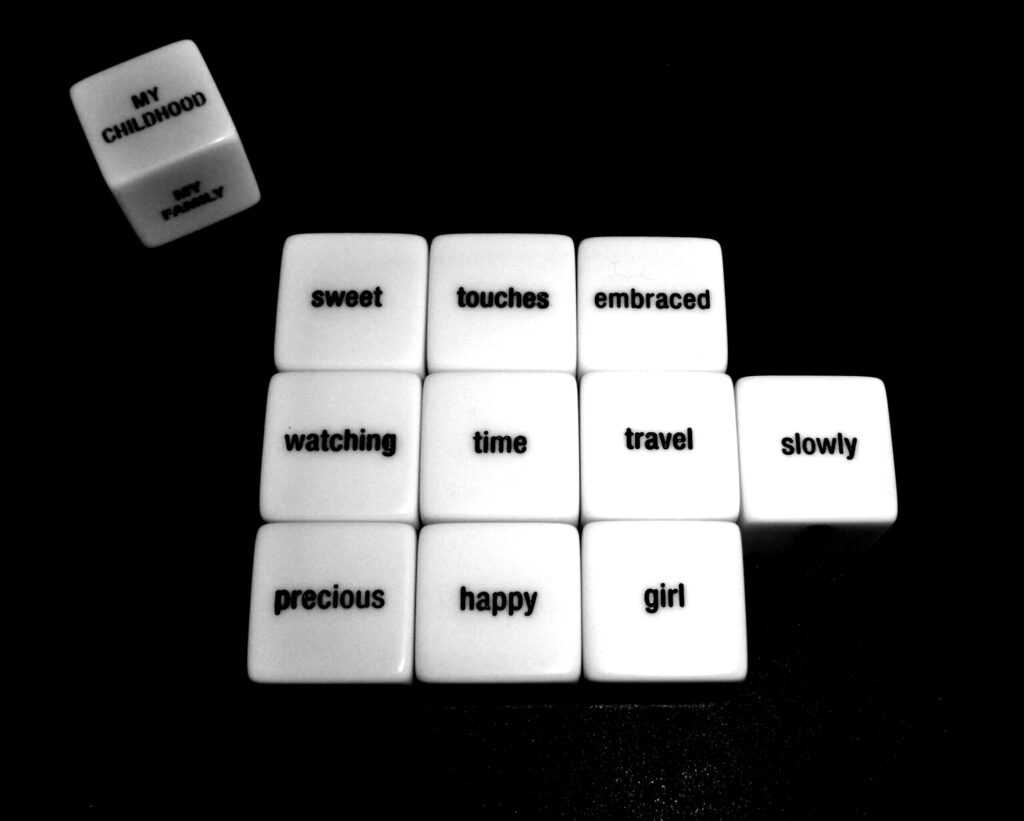
The 99 poems in Conor’s book are described as “dice-roll haiku” in all promotional writing, suggesting a variable element of chance in their production. The dice in question are “Haikubes,” a tabletop game marketed as an edutainment tool for creative writing classes. There are 63 individual six-sided “word cubes,” five faces engraved with a single word with one face blank. The only exceptions are the two “prompt cubes,” which contain full phrases such as MY ROMANTIC LIFE or MY FUTURE. The rules of the game are to roll all of the cubes together, the prompt cubes separated and used to set the tone and timbre of the poem, and the remaining words placed in rows on the backside of the box to form 5-7-5 haiku, the blank faces intended as spacers to be placed at the ends of each row.
A cursory look at the haiku in “old pond” (I will be using this as shorthand for the title) reveals the ways in which Conor has subverted these rules of engagement, or more aptly, has done away with them entirely. A good example:
#FFFFFF
time fortune
etc. journey
MY
ROMANTIC
LIFE
The title of each poem is a unique hexademical code, which provides no clues as to their nature or nurture, and seems to be entirely arbitrary. There is no consistent syllable structure, and the large space in the second line implies that blank faces are being inserted as the word cubes are arranged in rows (if they are being arranged at all). The last lines are a literal “prompt injection,” as the two phrase cubes are included in the poem structure and formatted exactly as they appear on the physical dice. The actual process by which the poems are composed is entirely inscrutable; it’s hard to tell if there was some arcane system for rolling the dice, if a select number of dice were rolled, if the entire set of 63 were rolled with adjunctive dice rolls to narrow down the selection, etc. The usage of blank faces does not follow any sort of pattern, as some poems will show much longer spaces between words in a single line. I attempted to follow some sort of faint internal logic, but would get totally thrown off by specific examples, such as this one, where somehow the same prompt is duplicated:
#0D0FAC
A
DESIRE
FOR we
its A
DESIRE
FOR an they
Any
A deeper investigation into the work as a whole starts to reveal wrinkles on the hand of fate. Of the 300+ possible words in a given roll, there are several that recur, and further, that follow the same order. Most damning are these two, which start with the exact same sequence of prompt phrases:
#D6101A
A
DREAM
ABOUT
MY
FAMILY-esque pregnant man
friendly she
#DDE64E
A
DREAM
ABOUT
MY
FAMILY fathom putrid
boy gorgeous a
These conceivably could have been produced by random dice rolls, but the likelihood is low, unless a prodigious amount of dice rolls occurred, since several poems include no prompt cube phrases at all. Both poems contain two prompt cubes and five individual words; I honed in on the number seven as a potential number of dice rolled from the full group, but it proved to be a red herring, as other poems contain far more individual words. The most that I could deduce was that the dice-roll haiku followed a strategy akin to John Zorn’s game pieces, in which hand signals and flash cards are used to guide musicians through actions and breaks, creating a sort of “controlled improvisation.”
The translucence of the concept does yield a closer look at the words as individual units; there seems to be an incentive for the player to pick intentionally quirky words for their final product, resulting in something more in line with “Cards Against Humanity” than a traditional haiku. And if we accept that the word order in “old pond” is intentionally selected, rather than randomly generated, Conor himself follows a similar logic with a different approach, as shown in the two below:
#58BAF9
clear crack slowly but
shady flock I one
looks pregnant of her
#0FAC68
MY
FUTURE torture
wicked consume full shady
war they or flock if
Many of the poems included present something ambiently violent, or sexual, or both, and the full set show a preference for some of the more bizarre vocabulary decisions made by the game’s creators; why are “mommy” and “daddy” included as options instead of just “mother” and “father” at the same syllable count? What about “jerk” or “pregnant”? Or “-esque”? Why is “etc.” included? (I can only imagine it’s meant as a kireji, but in this context it would be clunky, as it can only be paired with a single syllable word). Unconscious stylistic ley-lines are unearthed in DOE as well, as so eloquently examined by one Christian McDonough in his Hobart review, hinting at Conor’s “unauthorial” predilection for disinterring buried secrets within a provided text. But this all only holds up if we accept that the poems in “old pond” were indeed crafted with a hidden hand, even if said hand is giving us a vulgar gesture.
I’ve spent a fair amount of time speculating on the process behind this work, but ultimately, I am agnostic to the issue of aleatoriality; I’ll let those laboring in the realm of improvised music determine the merits of indeterminacy (or the question of if it can really exist in practice). And as these sonic scientists are aware, a large part of this problem depends on the idioms used and the arsenal of tools at the composer’s disposal. To demonstrate, I’ve crafted three haiku of my own:
New hydrogarden
Drosera capensis help
An epic comeback
Repotting advice
Sundew in interior
What’s going on here?
What i’m doing wrong
Is this a psittacina???
What type of fly trap?
These were sourced from a subreddit for carnivorous plant cultivation, using only the titles of posts. I would scroll to find the first 5 syllable line, then 7 syllables, then 5 again, restarting the process from the place I left off after one was finished. The process by which the individual haiku were arranged required very little input, but they end up containing markers of what a traditional haiku should have. Even at a quick glance, these “feel” like haiku, a reader would probably not even investigate the formal characteristics after making a snap aesthetic judgement. I can only imagine that my haiku were created with a lot less effort and time commitment than Conor’s (about 15 minutes), and are examples of true found text, albeit within a very accommodating environment. But if I’m being honest with myself, the haiku I hobbled together left me wanting; I find them pedestrian and somewhat insipid, limited in scope to the parochial concerns of exotic plant enthusiasts. I find more value in Conor’s spasmic and disjointed outbursts, even if “readability” is laid upon the altar.
Taken as a whole, it feels as though something is being said about haiku broadly, but I’m not entirely sure what. My first guess would be that “old pond” is a rehabilitation of free-form haiku, but I’m not entirely sure that even needs rehabilitating. Is there a critical intent here, and if so, what is the target? Is the work a polemic against the aesthetic characteristics associated with traditional haiku, or even against the form itself? Is it just a fun joke? You could ask Conor, but I have a feeling he may not want to give up the secret.